New York's retail silent response button, and the amendment that changed what it has to do
By Jim Hankins
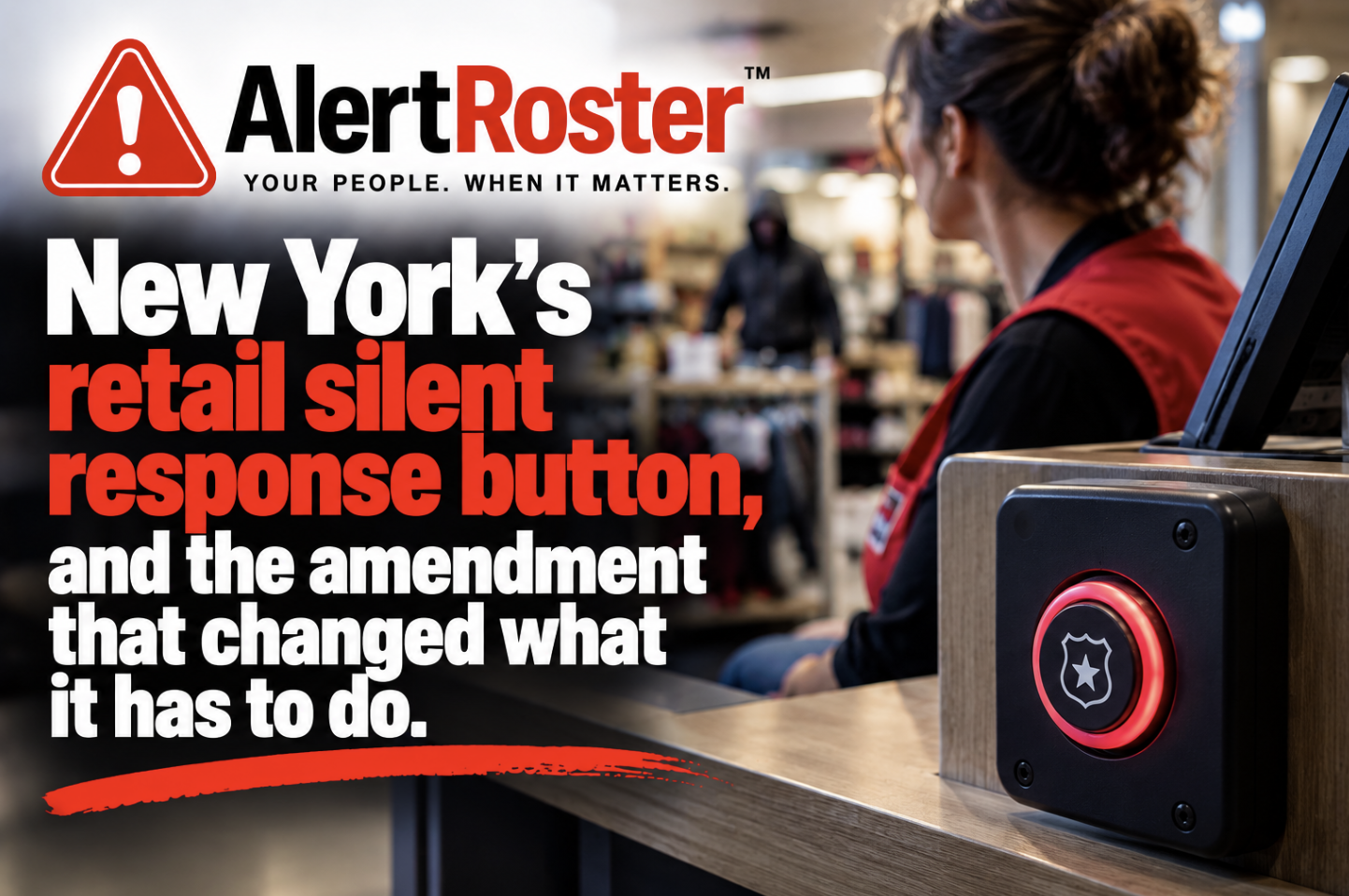
New York's Retail Worker Safety Act arrived in two parts, and the second part changed the requirement enough that anyone who evaluated vendors against the first version should look again.
What is required, and when
The workplace violence prevention policy and the training obligations have been in effect since 2025. The device requirement is separate and later:
Who: retail employers with 500 or more retail employees statewide. The original drafting counted employees nationwide. The amendment narrowed it to New York, which takes a number of national chains out of scope and leaves large in-state operators squarely in it.
What: a silent response button.
When: 1 January 2027.
The amendment is the whole story
As originally passed, the provision required a panic button that summoned local law enforcement. The chapter amendment renamed it a "silent response button" and changed what it has to reach. It now summons:
"a security officer, manager, or supervisor"
That is a different product category. A device that dispatches police is an alarm business function, and in most states it is a licensed one, involving a staffed receiving centre and a path into emergency services. A device that silently summons a manager is an internal escalation problem.
We will be straightforward about what that means for us. AlertRoster could never have satisfied the original version. The only emergency service we reach is Garmin Response, through automatic SOS on a Garmin inReach, and a requirement that the device summon police directly is one we cannot serve. The amendment is the only reason this market is open to us at all, and if New York had kept the original language we would be telling retail employers to look elsewhere.
It is worth asking any vendor in this space which version of the statute their product was built against.
Three permitted form factors, and the employer picks
The amended text permits a button that is:
"(1) stationary and positioned throughout the workplace, (2) wearable, or (3) mobile-phone based."
That list is doing a lot of quiet work. It means:
You are not obliged to buy a wearable per employee. Stationary buttons positioned around a store are explicitly compliant, and for a fixed retail footprint they are frequently the better answer. A button at the register, at the stockroom door, at the fitting rooms and in the back office covers the places incidents happen, costs less than a device per head, and does not depend on somebody remembering to carry it.
A phone app is permitted, but think about activation. New York does not spell out an activation standard the way Washington does. Washington's rule is explicit that a device is not simple to activate if the worker has to enter passwords or click "through multiple screens or applications". That reasoning is not binding in New York, but it describes a real failure, and a locked phone is a locked phone in either state. If you go phone-based, work out how a staff member actually triggers it during a confrontation.
"Silent" is a design requirement, not a detail. The point of a silent button is that the person causing the problem does not know it was pressed. Anything that beeps, flashes or visibly changes a screen defeats it.
What the button has to reach, which is the part people skip
The statute says the button summons a security officer, manager or supervisor. It does not say the button sends a notification and the obligation ends.
So the question an employer should be asking is the one that decides whether this works at all: what happens when the manager does not answer?
On a retail floor at 8pm, the manager is in the stockroom, on a ladder, dealing with a different customer, or on a break. A single notification to a single person is a system that works in the demo and fails on a Saturday.
What the requirement actually calls for, read practically, is an ordered escalation: the press reaches position one, and if nobody acknowledges, it reaches position two, and it keeps going until a human being claims it. That is a roster, decided in advance, with people who agreed to be on it and a backstop who always answers.
It is also the part that produces a record, which is what you will want if an incident is ever reviewed. Who was pressed, when, who was contacted in what order, and who responded.
How AlertRoster fits this one
This is the statute whose text lines up most closely with what we built, and we will say why without overstating it.
The form factor the law names first, stationary buttons positioned throughout the workplace, is a shape we support directly. A press raises an alert to the roster you configured and escalates through it until somebody acknowledges, with free unlimited watchers so you are never charged for adding the night supervisor or the owner to the list. The log at the end is exportable.
And the thing the amendment asks for, summoning a manager or supervisor rather than police, is precisely the thing we do and the only thing we do.
Where our limits are. There is no staffed centre here and nobody at our company is watching your stores. Alerts go to your own roster. We are not an emergency service. We contact one on your behalf only through automatic SOS on a Garmin inReach, which Garmin Response receives, and outside that we contact nobody but your own roster. We hold no life-safety certification. If your own policy or a local requirement obliges the device to summon police directly, we are the wrong vendor and we will tell you so.
We also cannot tell you that deploying us makes you compliant. That is a judgement for your counsel against your specific stores and staffing. What we can do is describe exactly what the system does, in writing, so the judgement can actually be made.
What to do with the time left
Confirm your headcount against the statewide threshold, not your national one. The amendment changed this and it is the first thing to get right.
Decide your form factor early. Stationary coverage is a store layout exercise. Doing it on paper now is much cheaper than discovering in December 2026 that you need twice as many units.
Build the escalation roster. Who, in what order, and who is the last line. If you cannot name position three, that is the real gap and no device closes it.
Read the amended text, not the original coverage. A lot of what was written about this law in 2024 describes a requirement that no longer exists.
Three months is a build window, not a scramble
If you are over the threshold, the useful work now is deciding your escalation roster and your form factor. Both are cheaper to decide than to retrofit.
Book a call — 20 minutes, and you will leave knowing whether this fits, including if the answer is no.
Not legal advice
This article describes what a published statute or rule says. It is not legal advice, and it is not a compliance opinion about your operation. Read the cited text, and take your own counsel's view before you rely on any of it.
What AlertRoster is, and is not
AlertRoster is a call-out notification and escalation tool. It notifies people who have agreed in advance to be notified, and records what happened. It is not an emergency service. It contacts one on your behalf only when your organization has turned on automatic SOS for a Garmin inReach registered to you: if you miss a check-in while your phone has no signal, the AlertRoster app declares an SOS on that inReach, and Garmin Response, Garmin's emergency coordination service, receives it under your organization's Garmin plan. It is not a fire alarm, a security alarm, or an alarm monitoring service, and it holds no life-safety certification. It is not a replacement for your team's official paging arrangements, and it should not be the only way a call-out can reach your people.
Sources reviewed October 2026. Statutes and rules change; if you are reading this long after that date, check the current text.
About the author
Jim Hankins is the founder and CEO of Cloud Bedrock, LLC and the developer of AlertRoster, which he first launched in 2009. A US Army combat veteran and a 42-year veteran of IT and software development, he has spent much of his career building emergency communications platforms, including as CTO of GEOS, the international emergency response coordination service later acquired by Garmin.