“Call me when you get there” and what happens when the call doesn’t come...
By Jim Hankins
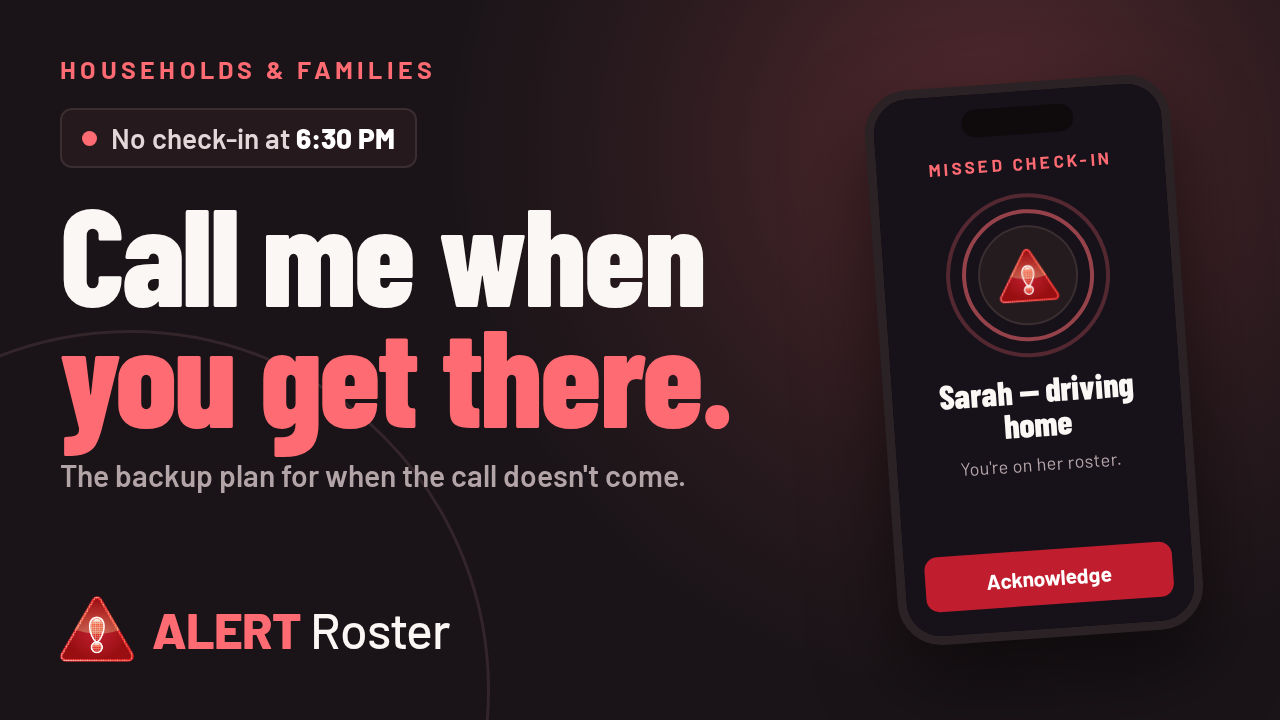
Every family has some version of the same sentence. Text me when you land. Call me when you get there. Let me know you’re home. It works right up until the moment it doesn’t. An then nobody is quite sure how long is too long to wait.
The problem isn’t the promise. It’s the silence.
Asking someone to check in is easy. Noticing that they haven’t is the hard part, because it requires somebody to be keeping time. In practice that job falls to whoever happens to be worrying, and it competes with sleep, work and the assumption that everything is probably fine.
Most of the time everything is fine. That is exactly why the habit erodes. A missed text becomes a shrug, then a pattern, and the one night it matters looks identical to the hundred nights it didn’t.
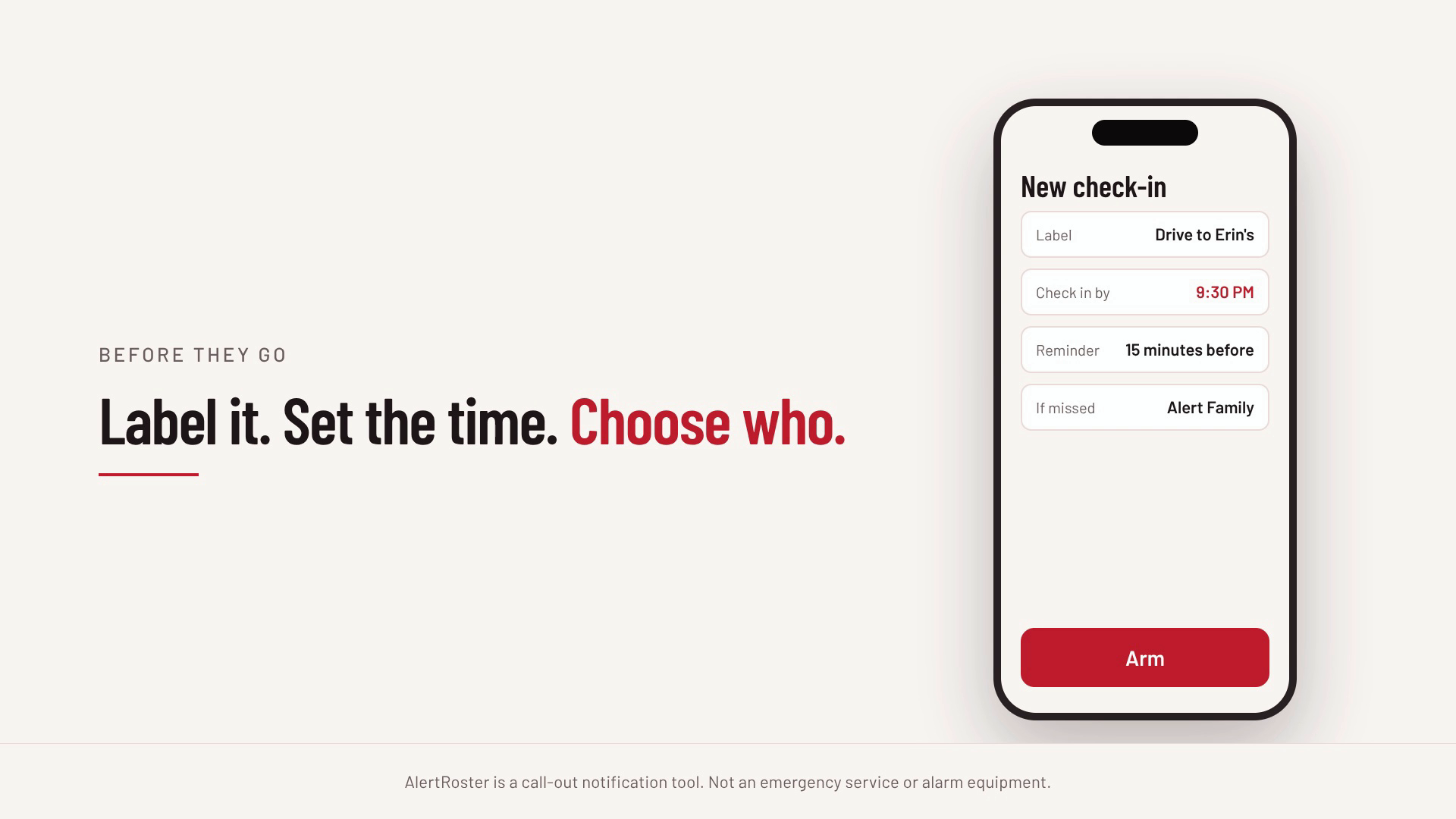
Arming a check-in: the window, and who is on the roster.
A check-in your family arms themselves
AlertRoster inverts the job. Instead of someone waiting to notice a silence, the person heading out sets a check-in before they go. They choose who is on their roster, how long the window is, and what those people are told.
Nobody else arms it. Nobody else can. A check-in has exactly one owner, the person it belongs to, and that is deliberate.
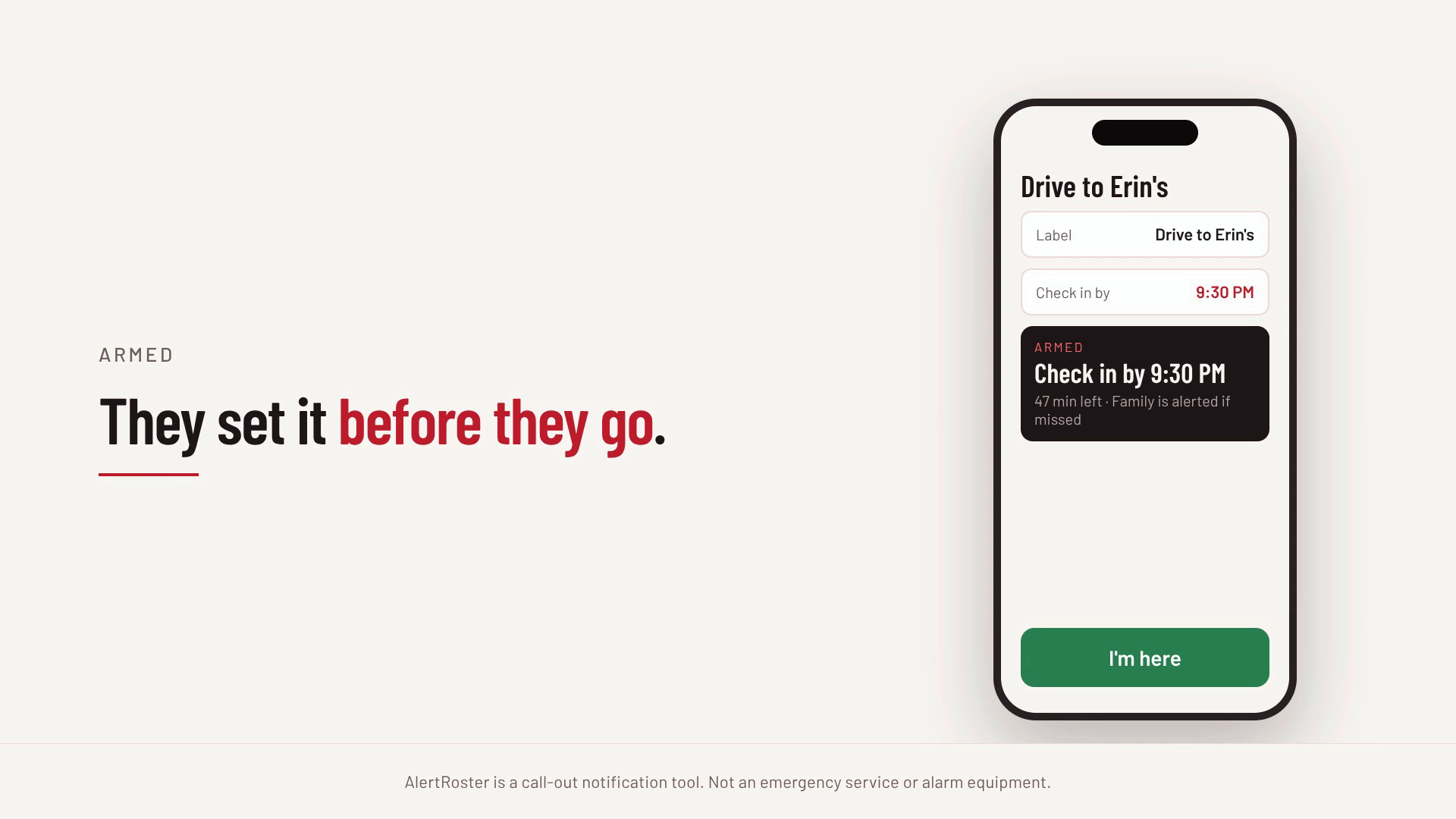
Plans changed. Extending the window is one tap.
Plans change, and the check-in changes with them
The dinner runs long. The drive takes an extra hour. Extending a check-in is one tap, and it is the normal case rather than the exception, a system that punishes ordinary life with false alarms gets switched off within a week.
When they arrive, they check in and it closes. No notification goes anywhere, and nobody is woken up.
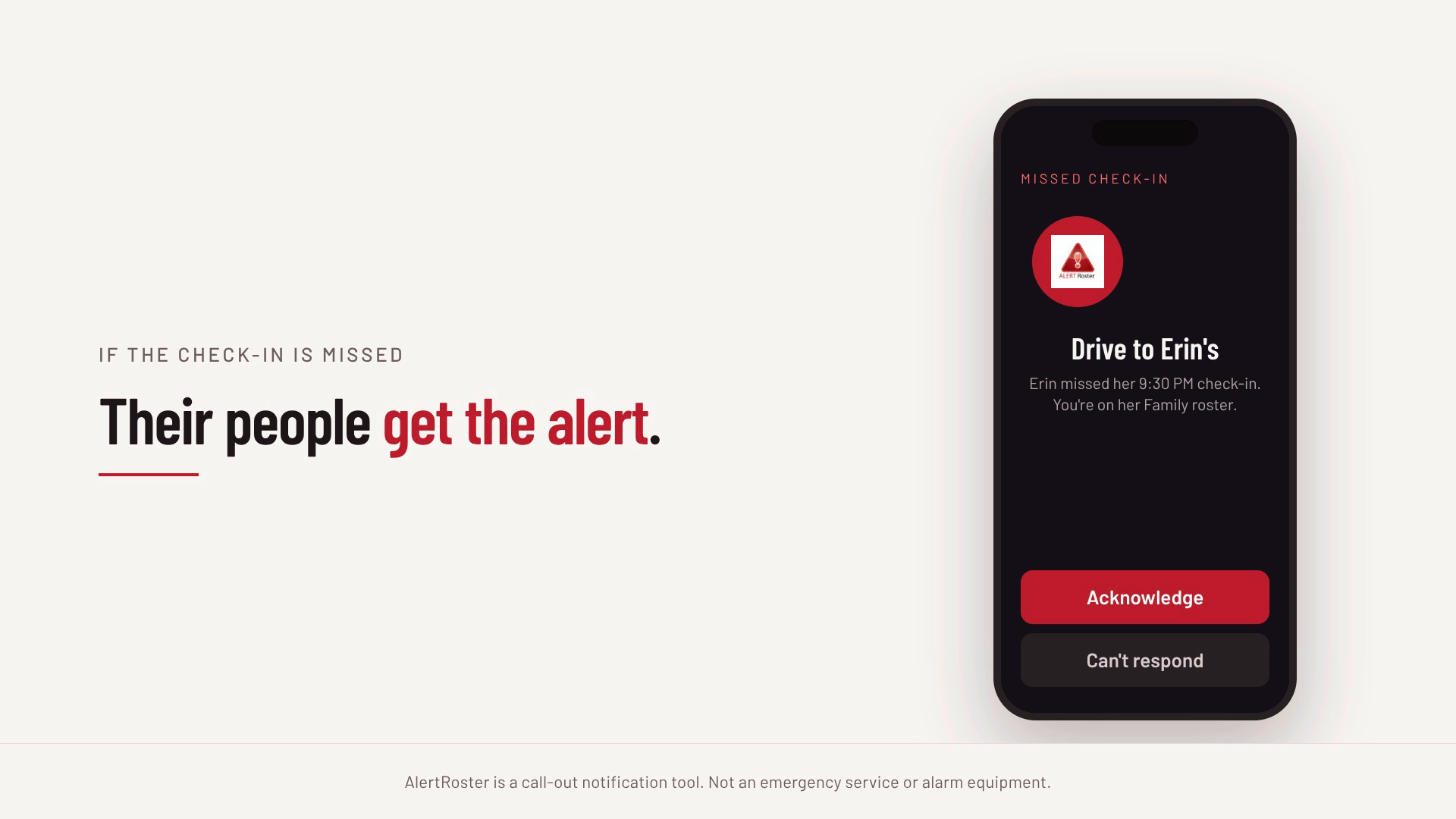
The check-in was missed. The chosen contacts are told.
If the check-in doesn’t happen
Only then does anything leave the phone. The people on the roster, the ones chosen in advance, are told that the check-in was missed, along with whatever context was set when it was armed.
That is the whole mechanic. It is not surveillance, and it produces no map of anyone’s day. It is a promise with a backup plan attached.
It isn’t tracking, and that distinction matters
Location sharing asks a family to accept constant visibility in exchange for reassurance, which is why it tends to get turned off by exactly the people it was meant to protect. A check-in asks for nothing until a moment that was already agreed.
The difference shows up in whether people keep using it. A tool that only speaks up when something was missed is one a teenager, a partner or a parent will actually leave switched on.
Who belongs on the alert roster
An alert roster is simply the list of people a call-out reaches, and the order it reaches them. The term comes from emergency services and the military, where a recall roster is how a unit is brought in at short notice.
For a household the same idea shrinks to something very ordinary: two or three names, ranked. A partner first, then a sibling, then the neighbor with the spare key. The ranking matters more than the length, a roster of everyone is a roster nobody feels responsible for.
Where alert rosters come from, and why the order matters.
Try it
AlertRoster is at alertroster.com. Setting up a check-in takes about a minute.
AlertRoster is a call-out notification and escalation tool. It is not an emergency service and does not contact one on your behalf. It is not a fire alarm, a security alarm, or an alarm monitoring service, and it holds no life-safety certification. It should not be the only way a call-out can reach your people.
About the author
Jim Hankins is the founder and CEO of Cloud Bedrock, LLC and the developer of AlertRoster, which he first launched in 2009. A US Army combat veteran and a 42-year veteran of IT and software development, he has spent much of his career building emergency communications platforms including as CTO of GEOS, the international emergency response coordination service acquired by Garmin in January 2021, and two successful exits. He has also volunteered in search and rescue, supporting the search for missing children.